Hardwood Floor Refinishing
Sand back to raw wood, fix what moved, and lay a finish built for a real household — pets, kids and Kansas City winters included.
Learn moreRepair
A damaged area is not a reason to lose the whole floor. Board replacement is routine work. The part that takes judgment is making the repair disappear into what surrounds it.
Build your quoteHow we approach it
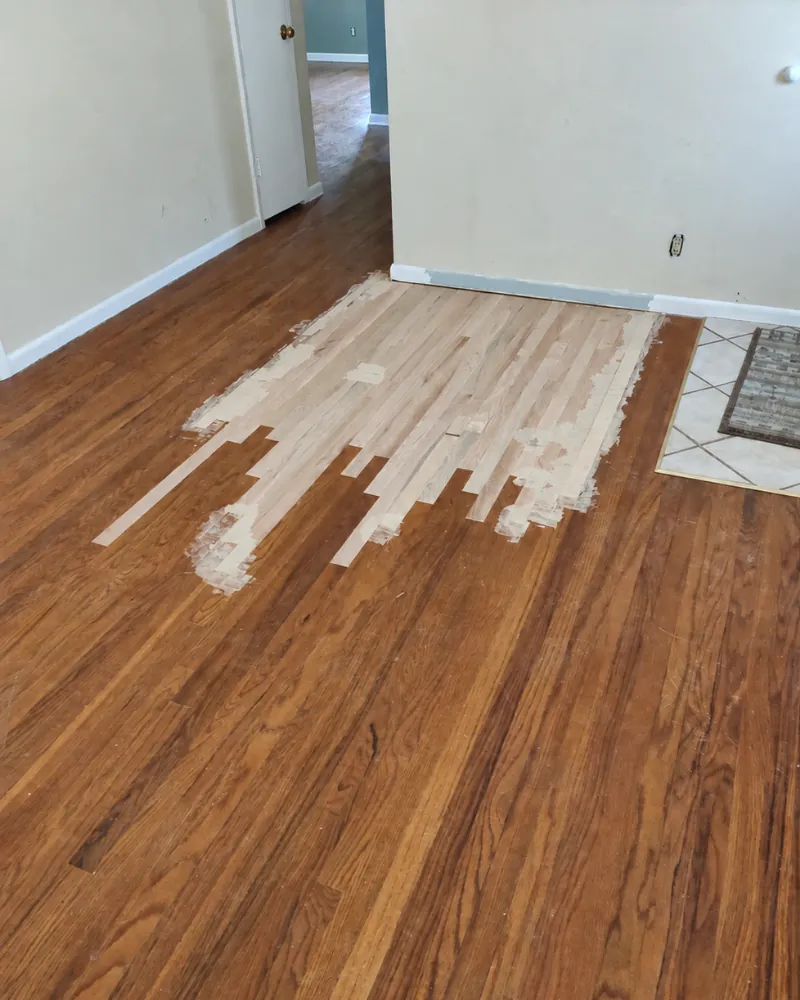
Matching is the real problem. A new board takes stain differently than wood that has been sitting under daylight for fifteen years, so a perfect color match on day one can read slightly off. We account for that instead of discovering it at the end.
Where the room closes off with a doorway, repairing and refinishing that room alone usually works cleanly. In an open floor plan the seam has nowhere to hide, and refinishing the connected area gives a result you will not notice — which is the point.
With water, timing matters more than technique. Cupped boards often flatten on their own once moisture equalizes, and sanding before that happens leaves boards thin in the middle. Sometimes the right first move is to wait and measure.
What your quote covers
Everything here is priced into the written estimate you approve before we start — not added to the invoice afterward. What changes from one floor to the next is what it needs and what you choose.
Is this the right service?
What it costs
Repairs do not price by square foot — the cause and the spread decide the work. Photos usually get you a straight answer the same day, faster than any visit we could schedule.
If a repair turns into a full refinish, you see both numbers before anything starts. Small jobs have a minimum, and we tell you what it is up front.
Get your rangeCommon questions
Board replacement in one area is routine. Matching the finish so the repair disappears is the hard part.
Read the full answerOften yes, if it dries out before the boards cup permanently or the subfloor stays wet long enough to grow mold. Speed matters more than technique.
Read the full answerLight surface stains sand out easily. Dark black stains usually do not — those are urine that penetrated through the finish and reacted with the wood, sometimes reaching the subfloor.
Read the full answerUsually not. Heated indoor air in winter is dry, wood gives up moisture, and boards shrink. The gaps typically close again in summer.
Read the full answerAlso from us
Sand back to raw wood, fix what moved, and lay a finish built for a real household — pets, kids and Kansas City winters included.
Learn moreSolid and engineered hardwood, acclimated before it goes down so it sits flat and stays flat once the heat comes on.
Learn moreVacuum-extraction sanders, plastic over the room, and cleanup of the areas we worked in — on every job, at no extra cost.
Learn more